
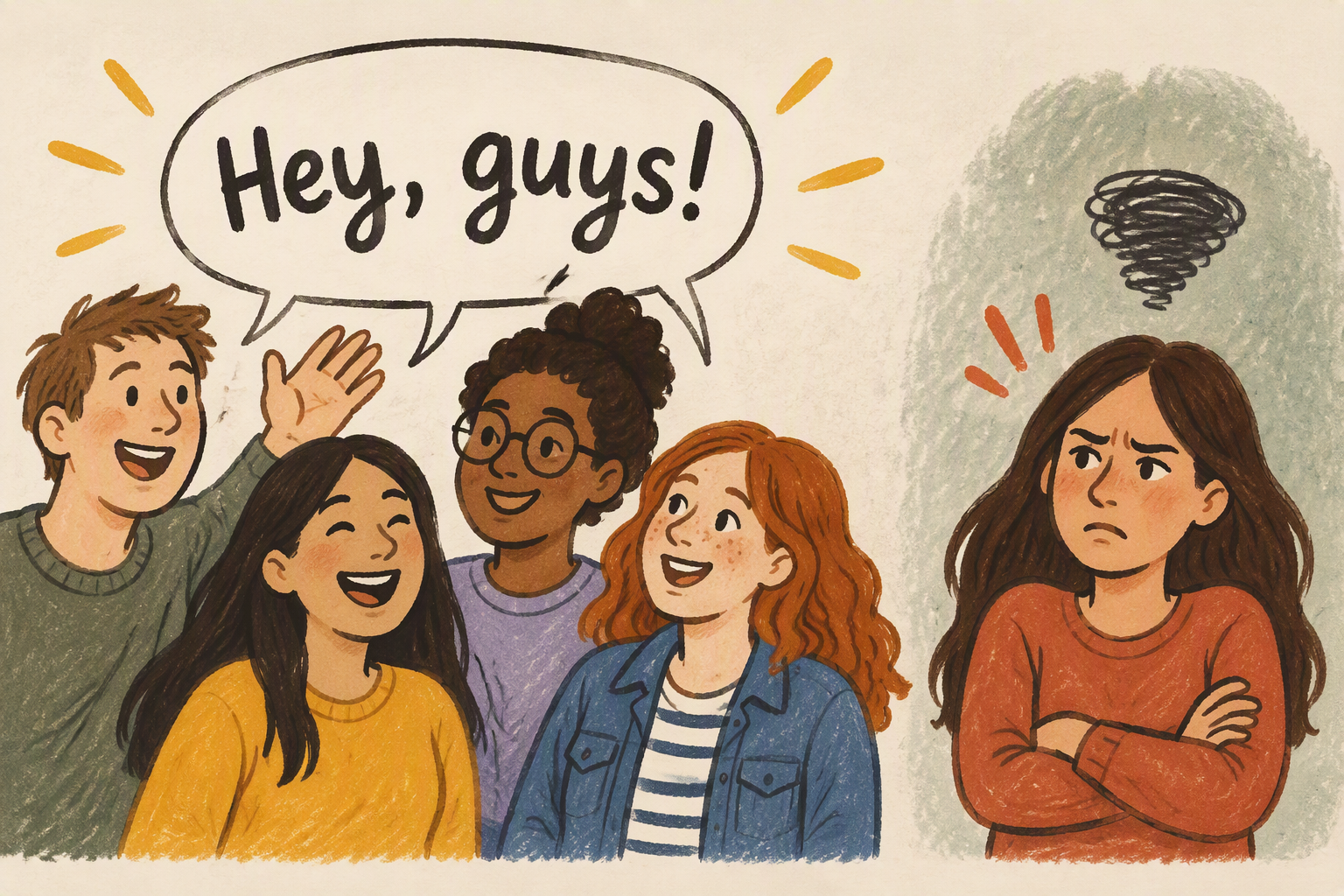
English grammar is squishy. Books abound on how to use it correctly. Yet people blithely violate the rules anyway, if not consciously. I say, go right ahead. It’s your language too. But I must put my foot down when people use guys to refer to everyone in the room, including women. They use it even if there are only women there. Besides, guy never refers to a female. So, how does guys get away with it?
If your reaction is Sheesh, lady, give it a rest, then this screed’s for you.
Turning the gender tables
Using guys this way reveals the same stealth-sexism in expressions like man on the street, the ascent of man, and mankind. Still think those expressions are okay? Then consider these sentences:
- I now pronounce you woman and husband.
- Five people were involved in the accident, including two men.
- I’d like you to meet Mrs. and Mr. Smith.
When I bring up the issue of guys being a sexist term, I am astonished at the blowback from men and women. Many retort defiantly, “Guys means everyone.”
Oh?
Would we feel comfortable walking into a room only of men and cheerfully saying, ‘Hey, ladies!’? Would a football coach ever bark, You girls better pick it up in the second half! and mean it as praise? Doubtful. Using a feminine-coded term in a male space is insulting. For them, girls is not only not neutral but a slur. And yet we casually refer to groups of all women as guys without blinking (or thinking).
Double standard much?
A little history of “guys“
Those who see guys as gender neutral are falling into the trap of using that male-coded language because it has been the default.
Using guys as an inclusive term is a linguistic sleight of hand. Broadly speaking, it’s not just that women haven’t been included; it’s that guys has been assimilated into a framework that still prizes masculinity as the norm. Research shows that calling mixed‑gender groups guys can increase male bias in mental imagery and decrease women’s sense of inclusion.
Even if the speaker intends the term to mean women too, it subtly signals that women are an afterthought and reinforces the lower status of women.
Since the 1960s, women have challenged the ways in which language covertly displays social attitudes towards men and women. For instance, we axed mailman, fireman, chairman, salesman, congressman, manpower, and man-made. The movement, titled the feminist linguistic shift, wanted people’s roles to define them, not their gender. We also did away with Mrs./Miss in favor of Ms., so as not to encode marital status. All those changes have stuck.
Options
People often ask me, “What should we say instead?” How about folks, everyone, audience members, readers, all, you, y’all, all of you, people, friends, and team? We don’t lack options; we’re just accustomed to using guys because it feels relaxed, familiar, and breezy. Some argue that it lowers the power differential between the speaker and the hearer (although no one would use it when speaking to superiors, such as bosses or professors). For all its benefits, it subtly upholds old gender norms.
Pass the Clorox
Linguists have an interesting term for the loss of guys’ male-specific meaning: semantic bleaching. That’s the process by which a word steadily loses some or all its concrete meaning and then functions in a more general, less emotional, or less abstract way. That is what has happened to guys. The male meaning has weakened but has not vanished. This bleaching occurs when a word or phrase has high-frequency usage along with low-attention to its semantic content. When people maintain that guys refers to everyone, it means they are no longer activating the “male part,” even though singular guy preserves one hundred percent of its male potency. That’s how they confidently state it means women too and become exasperated at any push back.
These words quietly signal that women don’t belong, even if the speaker intends for them to be. Put another way, you can say what you want, but you can’t control what I hear.
“Guys” In closing
The big picture is that language shapes who we see as important and who we default to. If our language consistently accepts male-coded words as universal, then we’re still trapped in old paradigms, whether we realize it or not.
You don’t have to be a curmudgeon to care about this. You just have to pay attention.
Sources:
Cameron, D. (2012). Verbal hygiene (2nd ed.). London: Routledge.
Crystal, D. (2019). The Cambridge encyclopedia of the English language (3rd ed). Cambridge.
https://www.doi.org/10.1097/SLA.0000000000002505
Harris, C. A., Blencowe, N., & Telem, D. A. (2017). What is in a pronoun?: Why gender-fair language matters. Annals of Surgery, 266(6), 932-933.
Stout, J. G., & Dasgupta, N. (2011). When he doesn’t mean you: Gender‑exclusive language as ostracism. Personality and Social Psychology Bulletin, 37(6), 757–769. https://www.doi.org/10.1177/0146167211406434
Leave a Reply