
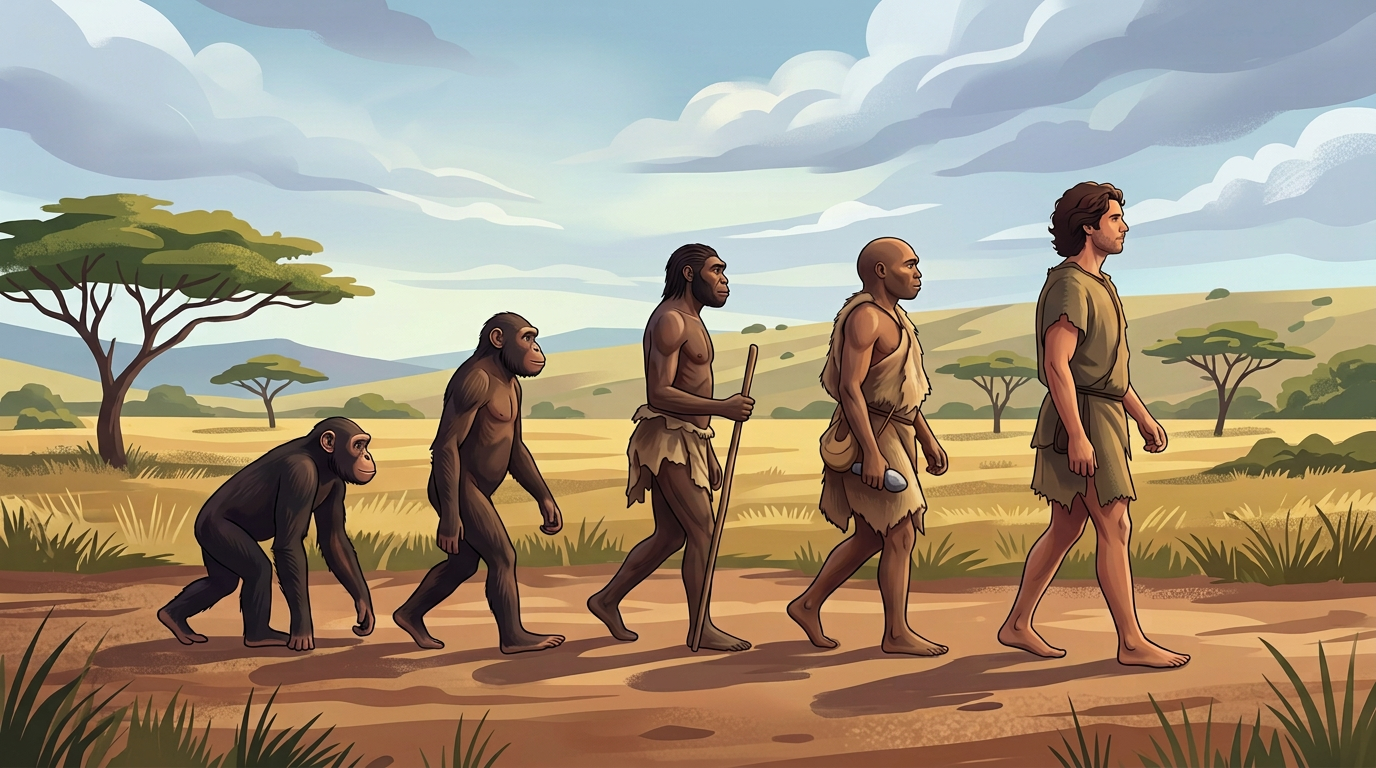
“Hundreds of millions of years of evolution have produced hundreds of thousands of species with brains, and tens of thousands with complex behavioral, perceptual, and learning abilities. Only one of these has ever wondered about its place in the world, because only one evolved the ability to do so.“
—Terrence Deacon
The Symbolic Species
What would you say is the greatest invention of human beings? Printing Press? Electricity? Computer?
“Speech,” American linguist Daniel Everett said, “is the greatest technological discovery ever made [and is] the basis for all subsequent technology. Linguistic communication is the most complex behavior known.”
Identifying the precise timeline when Homo sapiens began to speak has sparked lively debate. Soft tissue does not hold up over time, so experts rely on skeletal remains for crucial clues. Accordingly, here are three anatomical structures necessary for speech that developed roughly 100,000 and 50,000 years ago.
Hyoid bone
The hyoid bone is one piece of crucial evidence of the ability to speak. It anchors the tongue muscles above and the larynx below. It helps control tongue positioning and laryngeal movement, both essential for articulating different speech sounds, coughing, swallowing, and keeping us from choking.

Permission granted by Cleveland Clinic. https://my.clevelandclinic.org/health/body/hyoid-bone
All mammals have a hyoid bone. But fossils of both humans and apes show fundamental differences in its position. In humans, the hyoid sits lower in the throat. From this lowered position, scientists infer that early hominins possessed the anatomical capacity to produce distinct speech sounds, most notably Homo erectus, Neanderthals, and Homo sapiens.
Breathing
Once we became bipeds, our head sat directly above the spinal column, allowing the vocal apparatus, such as the larynx, to drop and change how we breathe. Unlike four-legged animals, whose breathing is linked to their rhythm of walking, we exhale 90% of our breath when speaking and inhale 10% of the time in quick breaths. This controlled airflow is necessary for speech rhythm and intonation.
Lips, teeth, and tongue
Other adaptations that accommodated the ability to speak include our teeth, which are vertical and smaller than those of apes, which slant outwards. Our upright teeth, combined with the intricate musculature of our lips, allow us to articulate sounds such as /f/, /v/, /p/, /b/, and /m/. Our tongue is also shorter and more muscular, permitting the formation of a variety of sounds inside the oral cavity.
Unfortunately, these modifications also mean a heightened chance of choking on food. However, the advantages of having more vocal power of speech far outweigh the possibility of choking.
Communication
These physical features tell us about the capacity for speech but reveal nothing about the process by which we came to produce meaningful, shared speech-like sounds. That complicated process hinges on abstract cognition and symbols, leading to Everett’s comment about language being “the greatest technological discovery ever made.”
In his video, Everett explained that the road to using symbolic speech had three steps. First came the index, which has a physical connection to its referent, like a bear’s footprint. Next came the icon that works by resemblance, such as a rock that happens to look like a human face.
Last, and the most radical leap of cognition, was the symbol. A symbol breaks with any connection to the physical world and is arbitrary. It needs no resemblance to the object referred to. Moreover, we need not be present for the meaning to be understood. Everett called this process “the original social contract” because we had to agree on what “arrowhead” meant or that two people could talk about it as a tool when it wasn’t present. Symbols could also refer to an event that never happened, such a mythical flood that covered the world, or concepts like justice and luck. Eventually, this symbolic thinking developed into language and how we speak, where meaning was tied to a sound (or gesture) that a community could understand and repeat.
What’s the payoff for having developed symbolic thought?
First, symbols let information outlive the person who has it. A chimpanzee can watch another chimpanzee crack a nut with a stone and imitate it, but the knowledge travels only as far as line of sight and only one generation at a time. A symbolic action, in contrast, enables us to name a technique, then describe it to someone who never saw it demonstrated. That person can eventually pass it on to someone in the future. That’s why human tools have a history and chimpanzee tools, largely, don’t.
Second, a symbolic thinker can plan a hunt for a season that hasn’t arrived, warn someone about a place never seen, or grieve a dead relative.
Third, and the biggest payoff for developing abstract thought, might be the least obvious one. Once a group agrees that an arbitrary sound stands for something, whether it’s a clan, god, or law, thousands of strangers can act on that same belief, and coordinate because of it. No other hominin species scaled cooperation past small bands of kin. Symbolic thinking and speaking lets us do that.
In Closing
Anatomy made the ability to speak physically possible, but the cognitive leap to arbitrary symbols is what made that speech into language. Language then let symbolic thought expand further than it could have otherwise.
Interestingly, Everett pointed out, evolution did not create symbols or grammars. “Human creativity and intelligence did. And that is why the story of how language developed must also be about invention rather than merely evolution. Evolution made our brains. And humans took over from there.”
I will leave you with one mind-blowing fact: Of the 20 hominin species that have walked the earth since the split from our last common ancestor seven million years ago, none developed language to the level of sophistication Homo sapiens has. All of them are extinct. Except us.
Sources
Algeo, J., & Butcher, C. A. (2014). The origins and development of the English language (7th ed.). Wadsworth Cengage Learning.
Beeker, M. (2025). The origin of language: How we learned to speak and why. Simon & Schuster.
Comrie, B., Matthews, S., & Polinsky, M. (2003). Atlas of languages: The origin and development of languages throughout the world. Facts On File.
Corballis, M. (2018). The origins and evolution of language [Video]. https://www.youtube.com/watch?v=nd5cklw6d6Q&t=2s
Deacon, T. (1997). The symbolic species. Norton.
Deacon, T. (2024). How we make sense of the world [Video].
https://www.youtube.com/watch?v=trh6YC-KIYE
Everett, D. L. (2017). How language began: The history of humanity’s greatest invention. Norton.
Everett, D. L. (2018). How language began [Video]. https://www.youtube.com/watch?v=qFxg5vkaPgk
Yule, G. (2020). The study of language (7th ed.). Cambridge.
Leave a Reply